
For chronic care management (CCM), remote patient monitoring (RPM), and remote therapeutic monitoring (RTM) programs, growth always runs into the same wall post-patient enrollment: ramping nurse care coaches to handle 1000s of patients needing follow-ups.
At CircleLink, we use RNs for our SphereCM platform, but despite RNs already being highly trained, getting them ready to handle real patient calls per each Dr.s’ workflow preferences, at the standard CircleLink holds itself to, has historically taken weeks of human-led orientation.
Clinical operations teams spend their days scheduling sessions, running live role-plays, and writing manual feedback. Meaning operations teams historically had to grow as these Care Management programs scaled. Scaling these teams means delays and excessive overhead costs, on top of the front-line RN costs.
That delay and linear cost is a growth bottleneck. SphereCM’s AI removes it.
There are two AI agents in the SphereCM platform that, together, have rewritten how CircleLink onboards Care Coaches:
Once the Hiring Agent has identified a strong candidate, the Orientation Simulation Agent takes over the next-hardest problem: turning a qualified RN into a CircleLink-grade Care Coach without burning dozens of hours of ops team time per cohort.
Traditional nurse orientation at CircleLink looked like this:
The result was predictable. Onboarding throughput was limited by how many Ops hours we had available. And the first dozen real patient calls were, by definition, the calls where the nurses were least prepared.
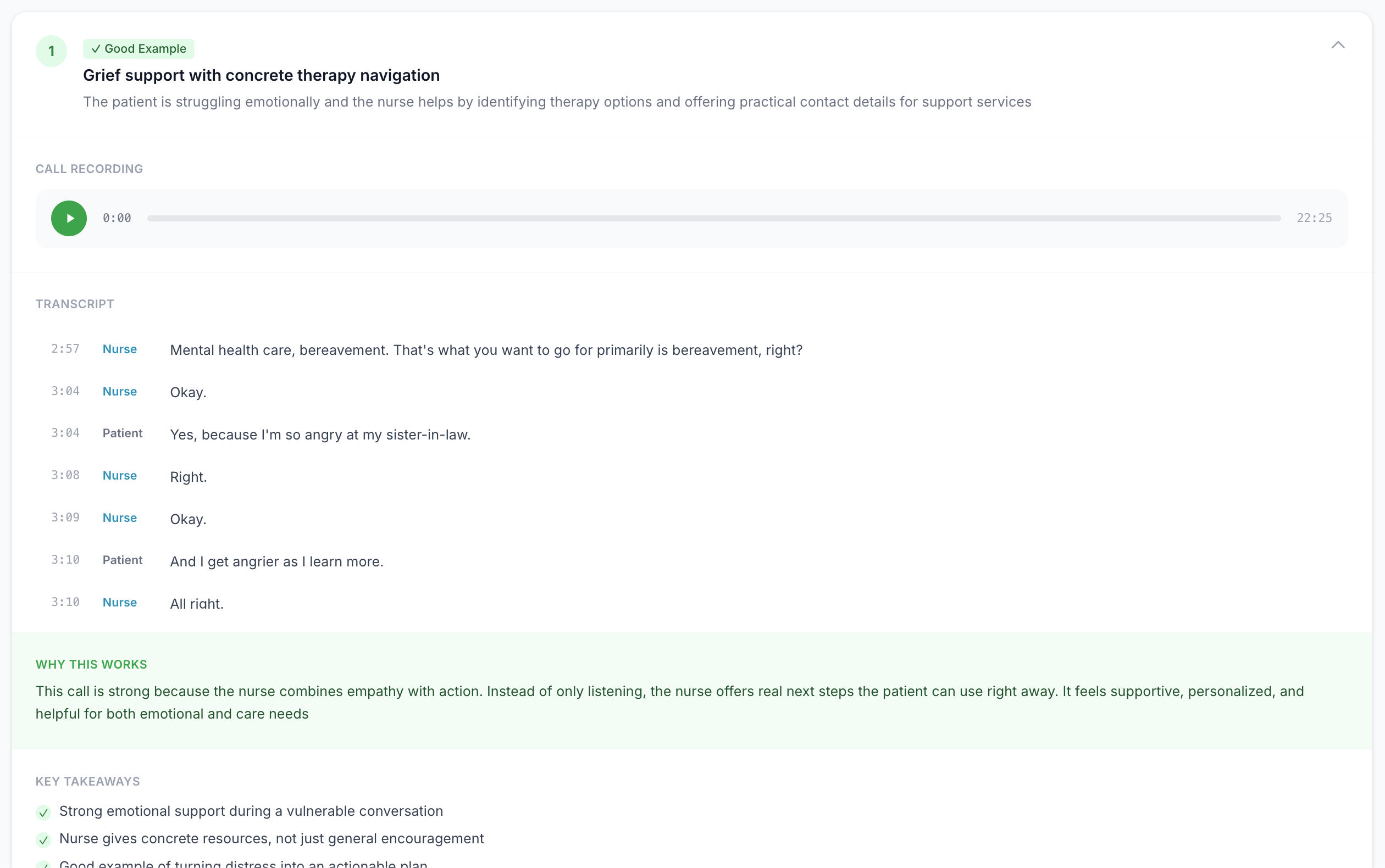
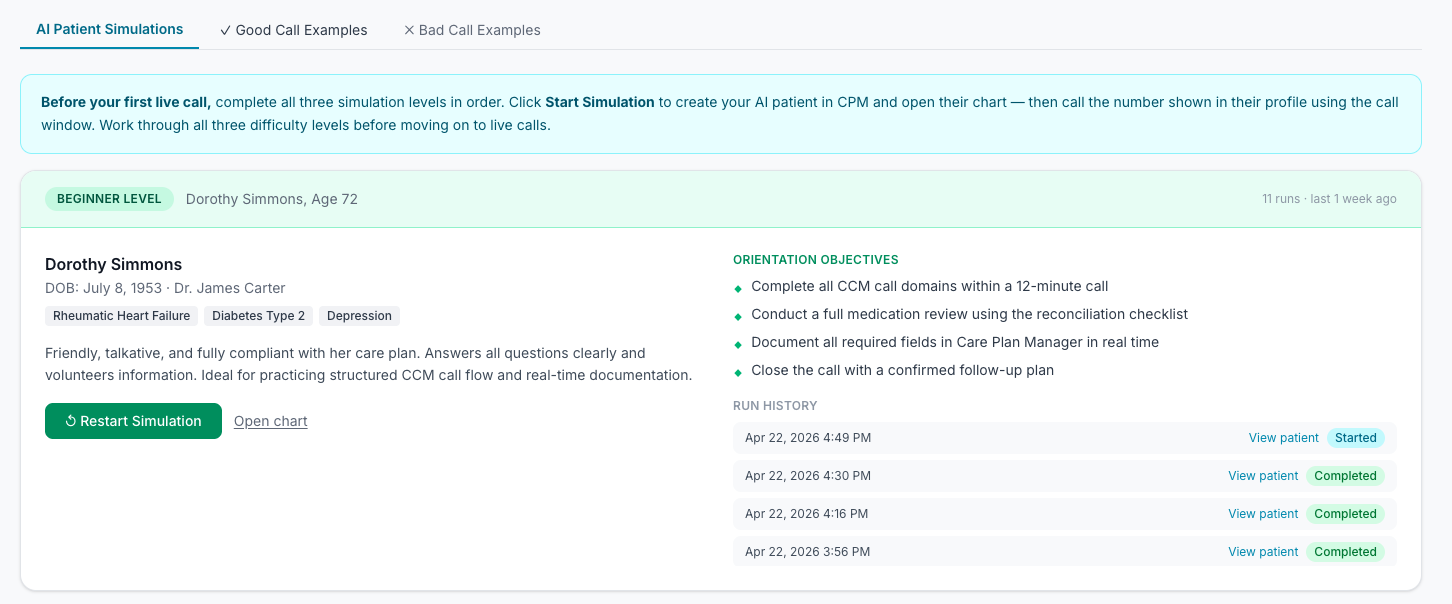
After receiving their onboarding email, new Care Coaches log into our system, read and review the workflow materials for the practices they're assigned to, and then move through two stages of orientation entirely on their own: 1) Reviewing/listening to real Care Coach calls picked to exemplify “good” and “bad” approaches, and 2) AI Patient simulations: Live, voice-based simulated patient calls based on our library of real patient calls.
1. Care Coaching Call Examples. Nurses review real (anonymized) patient call recordings, both strong examples and common mistakes, with full transcripts. The platform provides further orientation on "why this works" / "what went wrong" breakdowns, and key takeaways. “Good” and “Bad” examples include:
2. AI Patient simulations. Live, voice-based simulated patient calls inside our platform, modeled on hundreds of real CircleLink patient recordings. Nurses run full end-to-end workflows — conversation and documentation — exactly as they will on a live call.
This entire sequence happens during the nurse's first week. Ops stays available for questions, but no one needs to be scheduled, no one role-plays a patient, and no one has to be in the room. By end of week, the nurse transitions into real patient calls with an initial caseload. But now they have already practiced the workflows many times, with super realistic patients and scenarios.

The biggest time sinks under the old model are now either eliminated or reduced to edge-case review:
Ops still monitors AI training calls and provides manual feedback where needed — that's the one piece still being automated, with AI-driven evaluation in progress. But the day-to-day load of running orientation has been lifted off the team entirely.
"The AI patients were useful for my onboarding experience. I always feel like jumping in again." — Tara, RN
"I was impressed! I found them really useful." — Sophie, RN
"Extremely helpful for the onboarding process." — Janine, RN
CircleLink Care Coaches arrive at their first live CCM, RPM, APCM or RTM call already knowing what an evasive patient sounds like, what a real escalation feels like in real time, what excellent documentation looks like in SphereCM + Dr.s' EHRs, and what closing a call with a confirmed follow-up plan actually requires.
That's the difference between hiring a qualified nurse and deploying a CircleLink Care Coach. And with SphereCM, that difference is now something you can scale to any program size — without growing the Ops team that produces it.
Interested in seeing the SphereCM RN Orientation Simulator in action? Schedule a demo.